
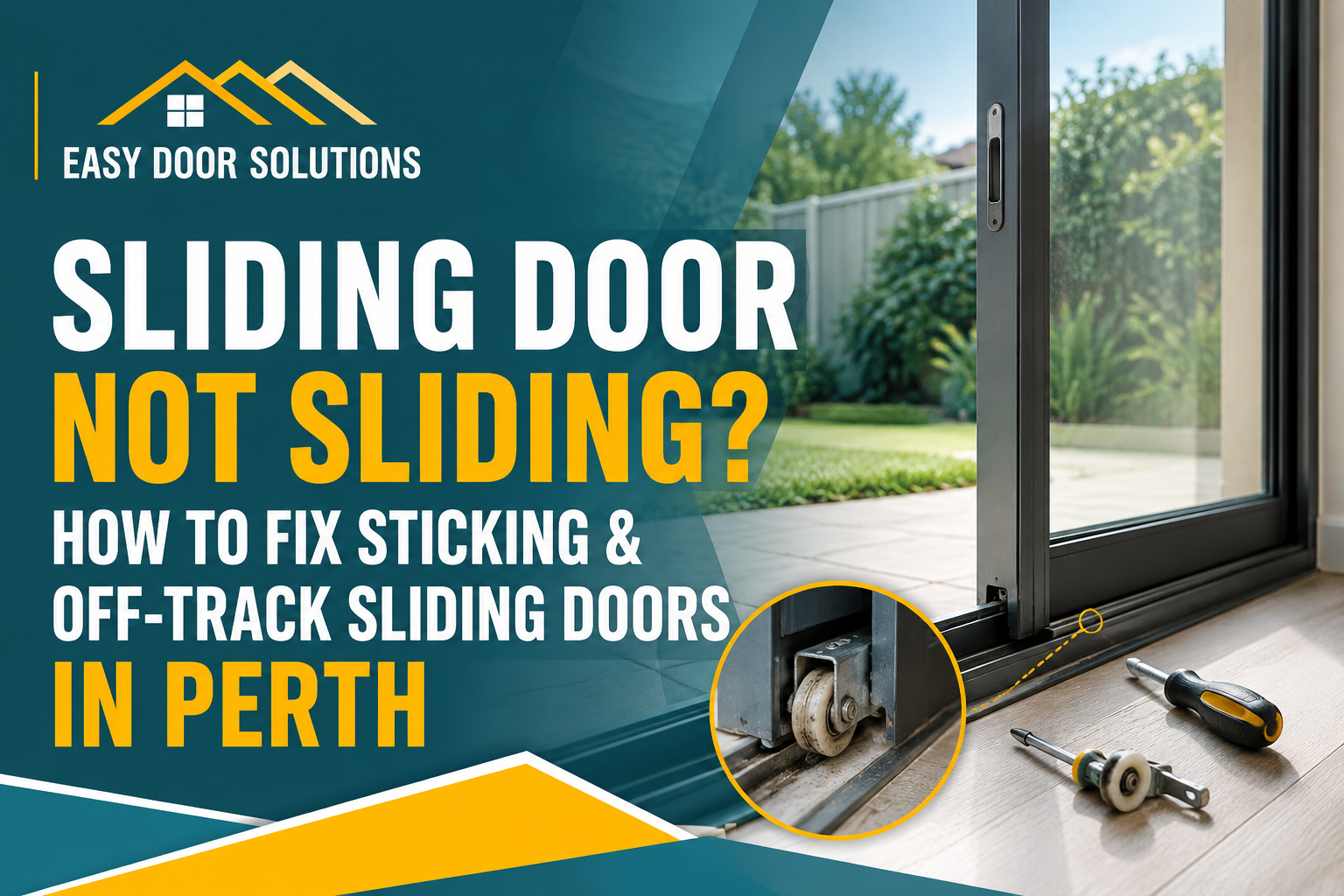
Why is my sliding door not sliding properly?
A sliding door usually becomes hard to move because of debris in the track, worn rollers, damage to the track, or a panel that has dropped out of alignment. Start by cleaning the accessible track and checking whether the door sticks in one particular spot. If it stays heavy, keeps leaving the track or no longer closes squarely, the rollers and alignment need professional inspection.
Nobody usually breaks a sliding door in one dramatic moment. The problem develops gradually — and that’s what catches most homeowners out.
When a door starts dragging, the instinct is to push harder. Forcing it makes the fault worse — grit works further into the track, and a twisting load goes through a heavy glass panel that wasn’t designed for it. Spend two minutes working out what the door is asking for first. Often you can sort it yourself; when you can’t, professional sliding door repair in Perth finds which component is causing the resistance instead of treating the symptom over and over.
Start with the two-minute check
Three quick checks narrow things down considerably.
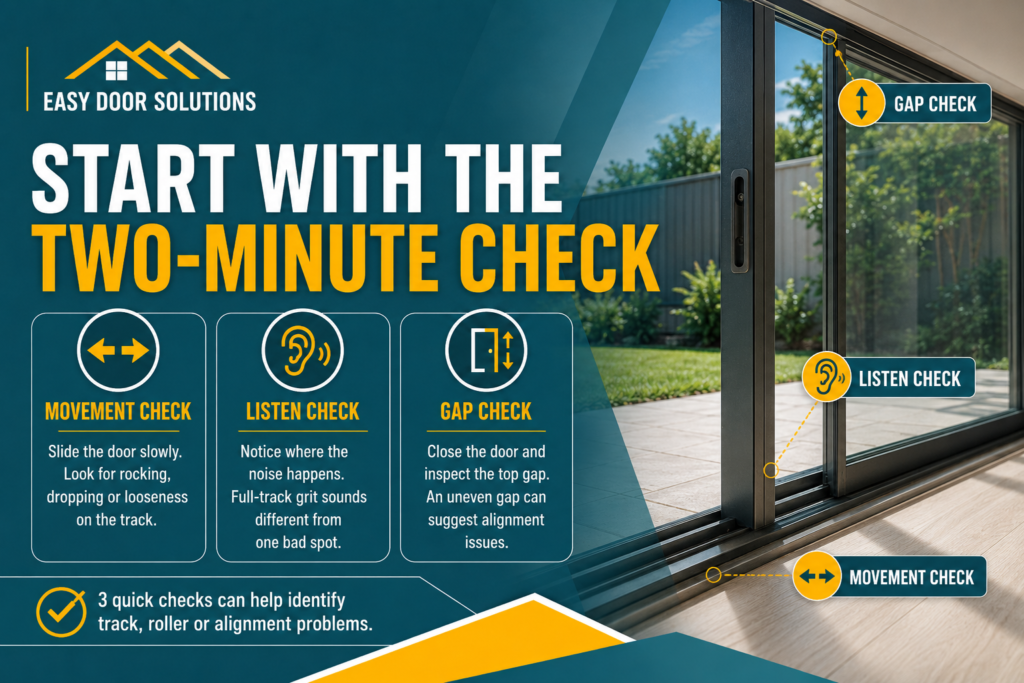
- The movement check. Slide the door slowly and watch how the panel behaves. Does it rock? Drop? Feel loose on the track? Try lifting gently at the handle and note whether there’s more play than you’d expect. Excessive movement, uneven height or a clunk as it settles can point to worn rollers, incorrect adjustment or another alignment issue.
- The listen check. Slide it end to end and notice where the noise happens. A gritty noise along the whole run can point to widespread debris, while noise that consistently appears in one spot may indicate local track damage or a roller issue.
- The gap check. Close the door and look along the top edge. That gap should be roughly even end to end. If it tapers, the panel has likely dropped out of square — which points towards adjustment rather than replacement.
Level 1: The fix that costs nothing
Noise along the whole run, but the panel sits square? The track is the place to start.
Here’s what most people get wrong about cleaning one: a broom shifts the loose sand sitting on top, which was never what stopped the door. The resistance usually comes from compacted grit packed into the corners of the channel, and that has to be broken up before it will lift out.
Vacuum both channels with a narrow nozzle. Work along the inside corners with an old toothbrush or stiff nylon brush to loosen anything crusted on, then vacuum again. Finish with warm soapy water. Hard orange-brown deposits may be mineral staining, particularly where bore-water reticulation overspray reaches the track — holding a damp cloth against them for a few minutes helps soften the residue before you wipe.
Let the track dry completely before sliding the door. A surprising number are simply finished at this point.
Level 2: Getting the lubrication right
If the door moves better but still isn’t gliding, it may want lubrication — and this is where good intentions can do damage.
The principle is straightforward: avoid oily or wet products on a sliding track. Light oils and some general-purpose sprays can leave a film that attracts dust and grit, creating additional build-up around the track and rollers. It’s why door manufacturers generally point towards dry, non-oily products for these components.
Where the door manufacturer recommends lubrication, use a suitable dry or non-oily product such as a silicone- or PTFE-based lubricant. Apply it sparingly to a clean, dry track and follow the instructions for your particular door system. Work the door back and forth, then wipe away anything pooling in the corners, since excess attracts as much dirt as the wrong product. For a stiff lock barrel, use a dry lock lubricant recommended for that particular lock rather than applying general-purpose oil.
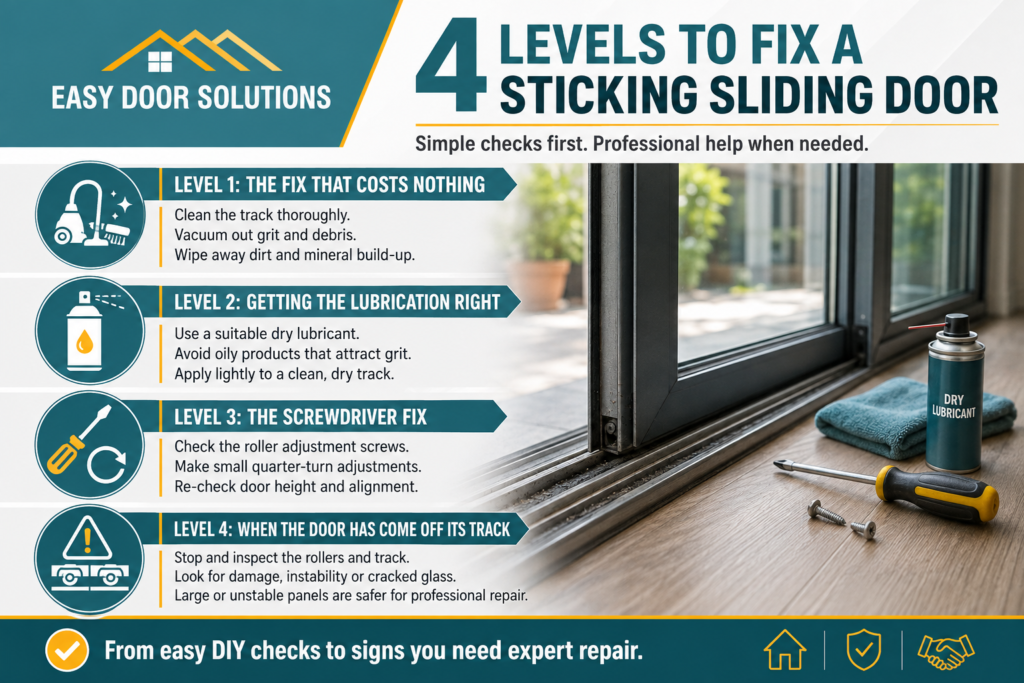
Level 3: The screwdriver fix
Failed the gap check? Your door may need adjusting — and there’s a good chance you’ve never noticed the screws that do it.
Check the bottom edge at each end for a small plastic cap or an exposed screw hole. Behind it sits an adjuster that raises and lowers that corner of the panel on its roller. On many sliding-door systems, turning the screw clockwise raises that side and anticlockwise lowers it — but adjustment mechanisms vary between manufacturers, so check your door’s instructions before you start.
Move in quarter-turns only. This is the step people rush, and rushing it means chasing the fault from one end of the door to the other for half an hour. Slide the door and re-check the top gap after every quarter-turn. You’re aiming for a panel that sits square, clears the track cleanly and latches without needing a lift.
If the screws are seized, stripped, or wound out to the end of their travel and it still drags, stop. That’s a roller problem wearing an adjustment problem’s clothing.
Level 4: When the door has come off its track
A door that has left its track needs more caution than one that simply feels stiff.
Glazed sliding panels can be large, heavy and awkward to control, and the correct method for lifting or reseating one varies between door systems — manufacturer instructions for larger panels commonly specify two or more people. Before anyone attempts to move the panel, check whether the track is damaged, the rollers are jammed, or the glass has visible chips or cracks. Any of those change the job considerably, and if the panel is large or unstable, professional help is the safer call.
There’s a practical point beyond safety too: if the door has come off more than once, putting it back won’t fix anything. Something in the roller, track or alignment is allowing it to happen, and that’s what needs attention.
Can I fix a sliding door myself?
Some of it, yes. You can often fix a sliding door yourself with nothing more than a vacuum and a screwdriver — cleaning the track, applying a suitable dry lubricant and making small roller adjustments all sit comfortably within DIY, and between them they resolve a good share of everyday sticking.
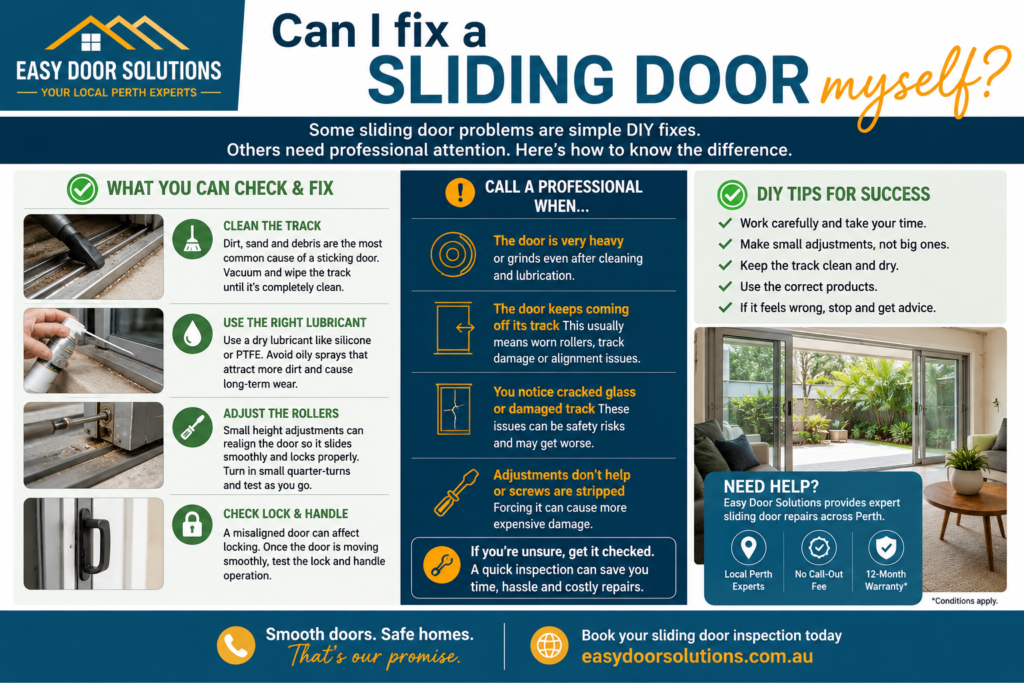
Where DIY ends is anything involving the panel itself. Replacing rollers means getting the door out and back in without twisting it — and that, rather than the rollers, is the difficult part. Track replacement, damaged glass and out-of-square frames sit in the same category.
Why Perth conditions can affect sliding doors
If your door has aged faster than you expected, local conditions are worth considering.
Perth homes expose door tracks and hardware to a particular combination: fine sand and dust carried on the afternoon sea breeze, reticulation overspray from iron-rich bore water leaving mineral deposits, and salt-laden air closer to the coast. High summer temperatures can also affect aluminium components and clearances, so some doors may feel different to operate during very hot weather.
How much any of this matters depends on where you live, how the door was built and how it’s been maintained. These conditions can affect how quickly tracks, rollers and other moving components accumulate wear, particularly in homes exposed to salt air, sand or reticulation overspray. If a door becomes noticeably harder to operate only during very hot weather, its alignment and clearances are worth checking before assuming major components need replacement.
A maintenance rhythm that suits the climate
Rather than a vague “clean it occasionally”, tie it to the seasons:

- Spring — before retic season, check where your sprinklers actually land and re-aim any hitting a door track.
- Summer — vacuum tracks more often if you’re near the coast. Peak sand season.
- Autumn — clean and re-lubricate after the summer load, and check flyscreens, since torn mesh feeds grit into the main track.
- Winter — run the movement check and look for developing roller, alignment or track problems before they become more difficult to manage.
A small amount of preventative maintenance through the year helps you catch developing problems while they’re still minor. The same habit suits sliding wardrobe doors, which run on their own rollers and tracks and benefit from similar attention.
What to tell us when you call
A few details on the phone get you a far better answer than “my sliding door is stuck”:
- What it’s doing — heavy throughout, catching in one spot, rocking, or leaving the track
- Door type — single slider, stacker, cavity slider or screen door
- Rough age, and whether it’s timber or aluminium framed
- Any marks on the glass, including chips at the edges
- Roughly where you are in the metro area, and whether the door is exposed to coastal conditions
That’s usually enough for us to arrive prepared, which can be the difference between one visit and two.
When Should You Arrange Sliding Door Repair in Perth?
It’s worth booking sliding door repair in Perth when the door repeatedly leaves the track, has become very heavy, is grinding audibly, has visible track damage, no longer closes or locks securely, or feels unstable — or when cleaning made no difference and the problem keeps returning. That’s usually the point at which people start searching for sliding door repairs near me.
There’s no call-out fee at Easy Door Solutions, so an assessment costs nothing if you decide not to proceed. We’re repair-first: where a door can be kept in service by dealing with the affected component, we’ll say so rather than quote a replacement. Weighing it up? Our guide to repair versus replacement works through the factors, and the warning signs worth acting on covers what to watch for earlier.
Why Choose Easy Door Solutions?
Most door companies quote replacements. We start from the opposite position: if your door can be kept in service by dealing with the component that’s actually failing, that’s what we’ll recommend — and we’ll tell you plainly when it can’t.

That approach is backed by how we charge:
- No call-out fee. Getting a professional opinion costs nothing, so there’s no penalty for finding out it was only a dirty track.
- We fix it or it’s free. We stand behind the diagnosis, not just the invoice.
- 12-month warranty on repairs. Covering the work and the parts we fit.
- Most repairs completed in a single visit, provided we arrive with the right components — which is why the details above matter.
- Pensioner discount available.
We work across the Perth metropolitan area on sliding doors, security and screen doors, flyscreens, windows and sliding wardrobe doors, for both homes and commercial premises.
About Easy Door Solutions
Easy Door Solutions is a Perth-based door and window repair specialist serving residential and commercial properties across the Perth metropolitan area, north and south of the river.
We handle the full sliding system rather than one part of it — rollers, tracks, alignment, handles, locks and key barrels — along with security doors, flyscreen re-mesh, shower screens, and new door and window installation where repair isn’t the right answer.
Licences and registration
ABN 97510964978 · Security Agent Licence No. 59227 · Security Consultant & Installer Licence No. 51622
Contact
0430 646 700 · sales@easydoorsolutions.com.au
Some Common Questions Related To Sliding Door
Why Has My Sliding Door Suddenly Become Hard to Open?
Sudden resistance is often debris in the track or a roller that has just failed. Clean the accessible track first — if the door is still heavy afterwards, the rollers and alignment need looking at.
Can Sliding Door Rollers Be Replaced?
In many systems, yes, provided suitable parts are available and the rest of the door is serviceable. The track and alignment should be checked at the same time, since roller wear is often not the only issue.
Does an Off-Track Sliding Door Need Replacing?
Not necessarily. If the panel and frame are sound, the door is often repairable — but the cause needs identifying first, particularly where rollers, track wear or alignment are involved.
Why Does My Sliding Door Scrape Against the Frame?
Scraping usually indicates the panel is no longer sitting evenly. Roller wear, adjustment or alignment issues can all bring part of the door into contact with the frame.
Does a Sticking Sliding Door Affect My Power Bill?
It can. A door that won’t seat properly against its seal leaks conditioned air, which adds up across a Perth summer. Our guide to door and window maintenance for energy savings covers the sealing side.
How Do I Find Sliding Door Repairs Near Me in Perth?
If you’re searching for sliding door repairs near me, look for a Perth service that inspects the complete sliding system — rollers, track, alignment, handles and locking hardware — rather than assuming the whole door needs replacing.
Still not sliding?
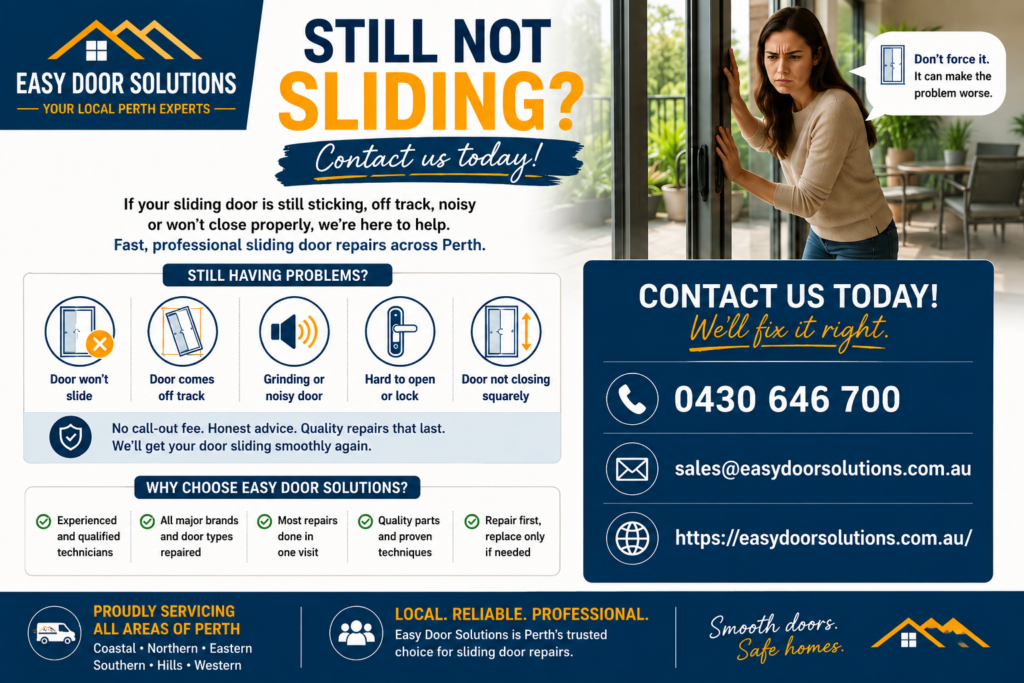
If the track is clean, the rollers are adjusted and it still takes a shove, you’re past the DIY line — and forcing it from here is how a repair turns into a replacement.
Easy Door Solutions provides sliding door repairs across Perth, with no call-out fee, a 12-month warranty* and most repairs completed in a single visit.
Call 0430 646 700 or book a repair online.